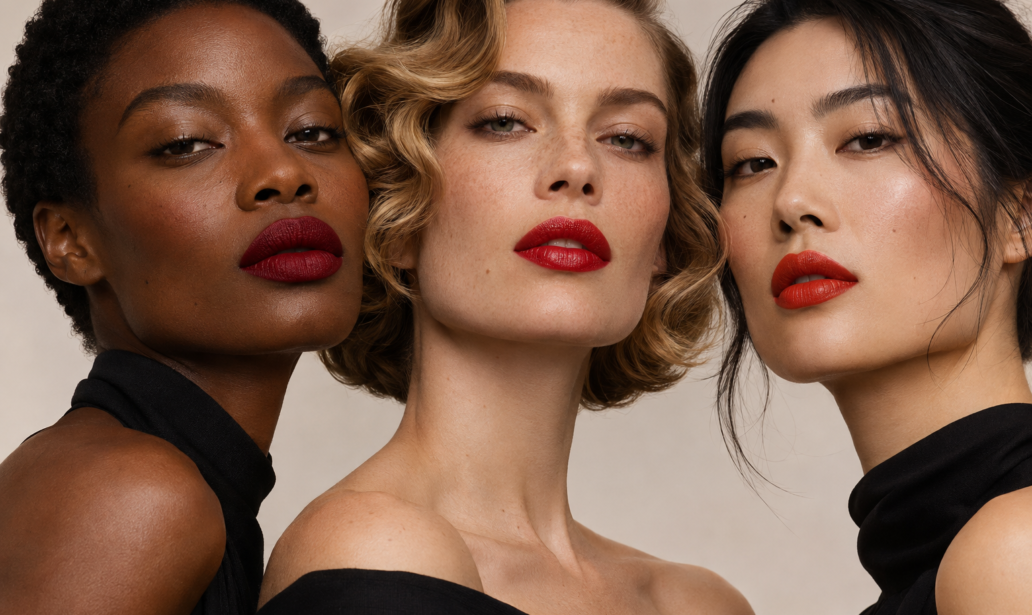
Some shades come and go, and then there is red. Every few seasons, someone declares the red lip back, as if it ever really left. It has lasted through a century of changing trends, and I think the reason is simple: red is never just one thing.
Why the red lip lasts
The same red can read as classic on one woman and expressive on the next. With a crisp white shirt and pulled-back hair, it looks polished. With a bare face and an undone look, it reads bold, maybe even a little defiant. On camera, it can carry an entire image.
That range is exactly why it endures. A red lip doesn’t carry one universal meaning. It takes its meaning from the person wearing it, the setting, and everything else in the look. Anyone who has spent time behind the makeup chair knows that a red lip on a bride, a red lip on a speaker walking onstage, and a red lip on a Saturday night are three very different statements.
A changing beauty standard
Lip color and lip shape have never stood still, and red has always been part of a larger picture of what a “finished” face looked like at the time.
The Victoria and Albert Museum offers a good window into this through an Elizabeth Arden brochure from the 1930s called Cosmetic Harmony. According to the V&A, the small, rosebud-shaped mouth of the 1920s gave way in the 1930s to a more natural lip shape, and the lipsticks shown in the brochure ranged from strong reds to lighter, more neutral tints. The rest of the face shifted too: brows were plucked or drawn pencil-thin, eye color moved away from the heavy kohl of the 1920s toward softer blues, greens, golds, and silvers, and rouge became more understated, aimed at a fresh, healthy glow. Nails were painted to match the face.
What I love about that brochure’s title is that it says what makeup artists still believe: the lip doesn’t work alone. A red was chosen in harmony with the brows, the eyes, the skin, and even the hands.
The following decade gave red another role. PBS reports that Lt. Col. Ruth Cheney Streeter, the first director of the U.S. Marine Corps Women’s Reserve, approached Elizabeth Arden in 1942 to create a standard makeup kit for every woman Marine, and that red lipstick was central to the polished look she wanted for her Marines. PBS also notes that the Marine Corps remains the only service branch that explicitly states women may wear red lipstick with all uniforms.
Since then, red has moved in and out of the spotlight alongside nudes, browns, glosses, and stains. It never disappears for long.
Red lipstick and visibility
There is a story often told about red lipstick and women claiming their place in public life. In its account of 1930s makeup, the V&A writes that Elizabeth Arden distributed red lipstick to Suffragettes, and later to women serving in the military during World War II.
It is a powerful story, and I want to be careful with it. The V&A doesn’t give dates for either event, and you will find the suffragette version retold online in many forms, some with more detail than the record can support. So I share it as the V&A tells it, not as the single origin of what red lipstick means.
Still, the thread is hard to miss. Across these moments, red shows up when women are stepping forward and choosing to be seen. That doesn’t make red a uniform for confidence. It makes it one of the clearest ways a woman can decide how visible she wants to be on a given day.
The reds that made history
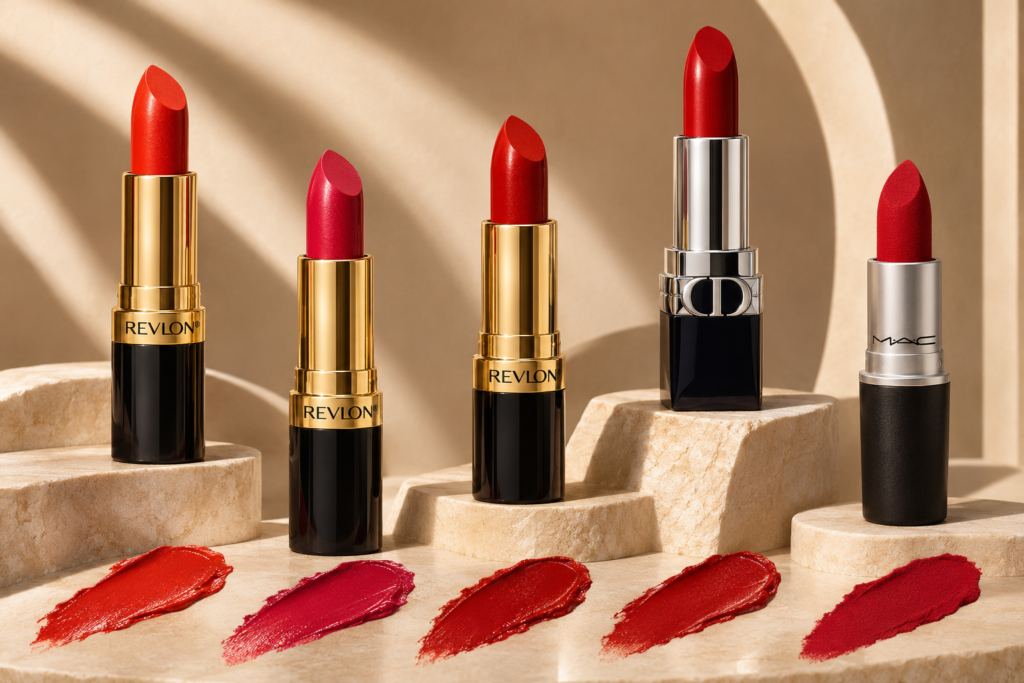
Some reds have outlasted every trend around them. A few are still on counters today, which says a lot about how good a classic red can be.
Revlon Fire & Ice. Revlon launched Fire & Ice in 1952 with one of the most talked-about beauty campaigns of the century. Richard Avedon photographed model Dorian Leigh for it, and the ad asked readers, “Are you made for Fire and Ice?” It is still part of Revlon’s Super Lustrous line. See the shade
Revlon Cherries in the Snow. Most accounts date this lipstick to 1953, though the name goes back further on Revlon’s nail colors. It is a cool, pink-leaning red, the kind that reads almost raspberry in some light. See the shade
Revlon Love That Red. One of Revlon’s oldest lipstick shades still on sale, and a true drugstore classic. It is a warm, true red that has stayed in the lineup for generations. See the shade
Dior 999. Christian Dior introduced Rouge Dior in 1953. According to Dior, its signature red, 999, takes its triple 9 from the house’s first two red shades, 9 and 99. Today, 999 comes in several finishes, including satin and velvet. See the shade
MAC Ruby Woo. MAC launched Ruby Woo in 1999 as part of its Retro Matte collection. MAC describes it as a very matte, vivid blue-red, and it has become one of the brand’s best-known shades. See the shade
What these reds have in common isn’t one undertone or finish. Each one gave women a clear, confident red they could come back to for years.
Famous red lips
For some women, a red lip has become their signature.
Dorian Leigh. One of the first supermodels, she was the face of Revlon’s 1952 Fire & Ice campaign, shot by Richard Avedon. Her scarlet lips and nails set the tone for a decade of matching reds.
Marilyn Monroe. Her red lip was built with care, not swiped on. Her longtime makeup artist, Allan “Whitey” Snyder, layered several shades of red, darker toward the edges and lighter in the center, to give her lips depth on camera. Makeup artists still use that idea today.
Madonna. According to MAC, she wore its Russian Red throughout her 1990 Blond Ambition tour. That shade later led, by accident, to the creation of Ruby Woo.
Dita Von Teese. The burlesque star has said she wears red lipstick every day. She has named MAC Ruby Woo as a favorite, and MAC created a red named for her.
Taylor Swift. Red has been part of her look for years. In 2014, she told MTV that NARS Dragon Girl was a red that “can’t go wrong,” and in 2015 she told People she had recently discovered Ruby Woo.
Rihanna. She loved Ruby Woo enough to create her own version with MAC, Riri Woo, in 2013.
Notice that none of these women wear red the same way. Monroe’s was layered and dimensional, while Von Teese’s is crisp and precise. Same color family, completely different statements.
From history to the makeup chair
This is where history meets real life. When a client asks me for a red lip, I don’t reach for “the” red. I ask what the red needs to do.
The occasion. A wedding, a portrait session, an evening event, a stage, or a video shoot all ask for something different. Photography and bright stage lights can change how a red reads, and a red that looks perfect in the mirror may look darker or flatter on camera.
The effect she wants. Classic and timeless? Soft and romantic? Strong and editorial? A blue-based red, a warmer orange-red, a deep brick, and a berry-toned red each tell a different story.
Her comfort. A woman who wears red every week can carry a full, saturated matte. A woman wearing red for the first time may feel more like herself in a sheer red, a stain, or a satin finish she can build up.
The rest of the look. The red has to sit comfortably with her skin, her eye makeup, her hair, and what she’s wearing. A strong red usually wants a quieter eye. A softer red can share the stage.
I’m not a fan of rigid rules like “one red suits everyone” or “never wear red if you have a certain skin tone.” The right red is found by trying a few shades on the actual person, in context, and watching what happens. You can usually see it in her face before she says a word.
A polished application
A red lip is unforgiving. Every uneven edge shows. Here is how I approach it.
Prepare the lips. Gently smooth away any flaking, then apply a light balm. Give it a few minutes, then blot so the color has a smooth, not slippery, surface to grip.
Define the shape. Use a lip liner close to the lipstick shade, or a neutral liner that matches the natural lip. Follow her natural lip line. Small adjustments, like softening an uneven corner or evening out the bow, are fine; redrawing the mouth into a different shape usually isn’t.
Apply with control. A lip brush gives the cleanest result. Start in the center and work outward toward the corners. Blot, then apply a second layer for depth and wear. Fill in the liner lightly underneath if you want the color to last through a long day.
Clean the edges. A small flat brush with a touch of concealer sharpens the outline and fixes any wandering color.
Check it in the light that matters. Look at the lip in daylight, under the venue’s lighting, or through the camera if it’s being photographed. Adjust before she leaves the chair, not after the first photo.
Plan the touch-up. Send her off with the lipstick, the liner, and a small mirror, plus blotting papers if she needs them. After eating, it’s better to blot and reapply cleanly than to layer over what’s left. For a bride, hand the kit to someone she trusts so she doesn’t have to think about it.
For working artists
The consultation is where a great red lip actually begins.
Ask what she wants the red to communicate. Polished and professional? Romantic? Fearless? Her answer tells you more than her skin tone ever will. Ask where she’ll wear it, how long she needs it to last, and how often she wears lipstick at all.
Then explain her options clearly. Show two or three reds side by side on her, and talk through the trade-offs in plain language: a matte lasts longer but can feel drier; a satin is more comfortable but needs more touch-ups; a stain is easy to wear but less dramatic.
And finally, make it hers. The goal isn’t to put the red of the moment on her face. It’s to create a look that feels like her, so she spends the day enjoying it instead of wondering whether it suits her.
A choice, not just a shade
Red lipstick has been part of polished faces, uniforms, celebrations, and quiet acts of self-expression for generations. It carries history, and it carries whatever the person wearing it brings to it.
So the next time you reach for a red, think about it as a choice with personal and cultural context, not just a color in a tube. What do you want it to say today?


